Astronomers Detect First Atmosphere on Rocky Exoplanet in Habitable Zone
07/18/2026 / By Iva Greene

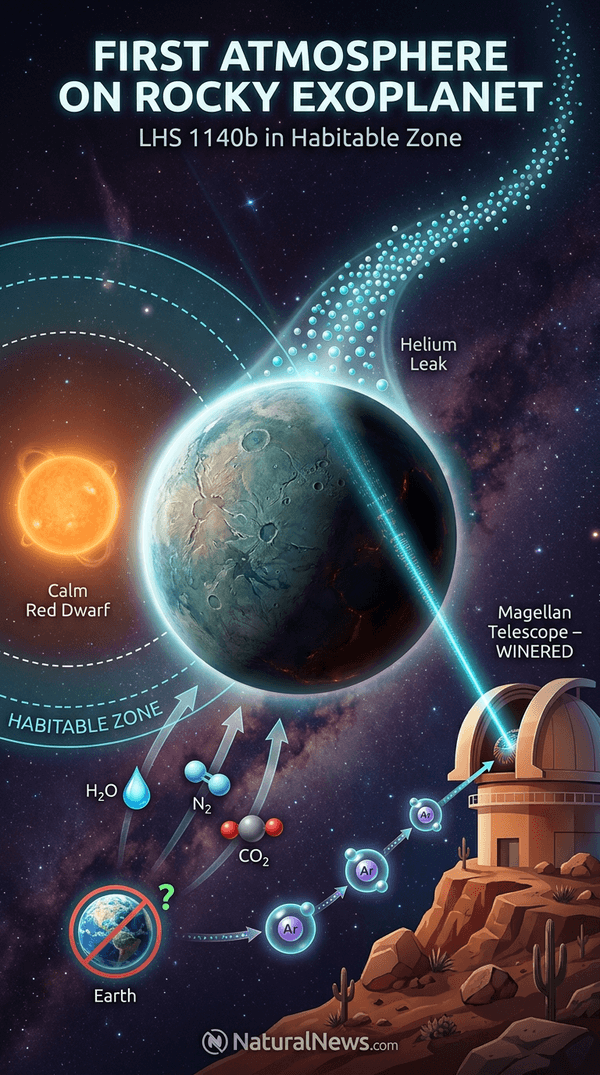
Astronomers have detected an atmosphere on a rocky planet within a potentially habitable zone outside the Solar System for the first time, according to a report by a Harvard-led team of scientists. The findings, published in the journal Science on July 17, 2026, stem from analyzing data on the super-Earth LHS 1140b, which circles a red dwarf star 49 light-years from Earth. The discovery was based on traces of helium escaping the planet, officials said. [1]
Lead author Collin Cherubim, a planetary scientist at the University of Chicago, said in the report that “an atmosphere is essential for a planet to support life as we know it.” He added, “This is the first time anyone has found an atmosphere on a rocky planet in the habitable zone of another star.” [1]
Planet Characteristics and Location
LHS 1140b orbits a red dwarf star in the constellation Cetus, with a mass approximately 5.6 times Earth’s and surface gravity nearly double Earth’s, according to the study. The planet is tidally locked, with one hemisphere always facing its star, and may hold significant water reserves, scientists said. [1]
Red dwarf stars are typically more volatile than the Sun and tend to blast off flares that can strip small, close-orbiting worlds of their atmospheres. The red dwarf near LHS 1140b, however, is unusually calm, which may explain why the planet retained an atmosphere, researchers noted. [2]
Earlier research has suggested that many exoplanets may possess water-rich atmospheres, according to a model developed by University of Chicago scientists Edwin Kite and Laura Schaefer. [3]
Detection Method and Atmosphere Composition
The atmosphere was identified by detecting helium escaping the planet’s upper atmosphere using the WINERED spectrograph on the Magellan Clay Telescope in Chile, the study stated. The instrument caught helium thinning at high altitude, indicating a steady leak from the planet’s exosphere. [1]
Lead author Collin Cherubim said the team observed helium thinning at high altitude, a sign the gas is steadily leaking from the planet’s upper atmosphere. The exact makeup of the atmosphere remains unclear, but earlier studies suggested the presence of nitrogen, possibly mixed with water vapor and carbon dioxide, according to the report. [1] Educational materials on atmospheric science note that different gases at the same volume, temperature, and pressure have the same number of particles, which aids in interpreting spectrographic data. [4]
The detection technique is analogous to how weather balloons measure atmospheric properties at high altitudes, providing data on gas composition and density. [4]
Significance and Limitations
Cherubim emphasized in the report that “at this point, we have absolutely no evidence for life on the planet,” but noted that “we think all of the really important, essential ingredients are there.” The planet’s resemblance to Earth in bulk composition and temperature makes it a prime target for astrobiology studies, according to the report. [1]
The planet’s red dwarf star is unusually calm, which may have allowed the atmosphere to persist, unlike typical flares that strip nearby worlds, officials said. Small stars are known to be far more active than larger ones, making them dangerous to attendant planets. [2] Researchers cautioned that while the presence of an atmosphere is necessary for life as we know it, it is not sufficient evidence of life. [1]
Future Implications and Observations
The discovery positions LHS 1140b as a key target for astrobiology studies, though no spacecraft can reach it. NASA’s Voyager 1, the fastest human-made interstellar object, would require roughly 860,000 years to cross the distance to the planet, according to the report. [1]
Researchers plan further observations to determine the atmospheric composition, with potential implications for understanding habitable conditions on exoplanets. Ongoing detection efforts for other worlds include laser-based techniques for identifying life signatures on moons like Europa. [5] The discovery adds to a growing list of exoplanets with detected atmospheres, building on earlier work such as the identification of water vapor in the atmosphere of WASP-39b. [6]
References
- RT News. “Astronomers make landmark discovery on next-door ‘super-Earth'”. RT. July 17, 2026.
- NaturalNews.com. “Can small stars support alien life? An astrophysicist talks about the potential these exoplanets may have”. NaturalNews.com. July 3, 2018.
- NaturalNews.com. “New model suggests several planets in the universe might have water-rich atmospheres”. NaturalNews.com. March 23, 2021.
- Angelica M Stacy. “Weather gas laws and phase changes”.
- Willow Tohi. “Laser technique could spot life on Jupiter’s moon”. NaturalNews.com. March 13, 2025.
- NaturalNews.com. “NASA has identified an exoplanet with large amounts of water”. NaturalNews.com. March 23, 2018.
Explainer Infographic
Submit a correction >>
Tagged Under:
astronomy, celestial bodies, Chile, constellation Cetus, discoveries, exoplanets, habitable planets, habitable zone, LHS 1140b, liquid water, Magellan Clay Telescope, NASA telescope, new planets, red dwarf star, space exploration, space telescope, super-Earth, super-Earth LHS 1140b, WINERED spectrograph
This article may contain statements that reflect the opinion of the author
RECENT NEWS & ARTICLES