The Great Pyramid’s secret architecture: New research claims inner voids are ancient construction highways
05/08/2026 / By Jacob Thomas
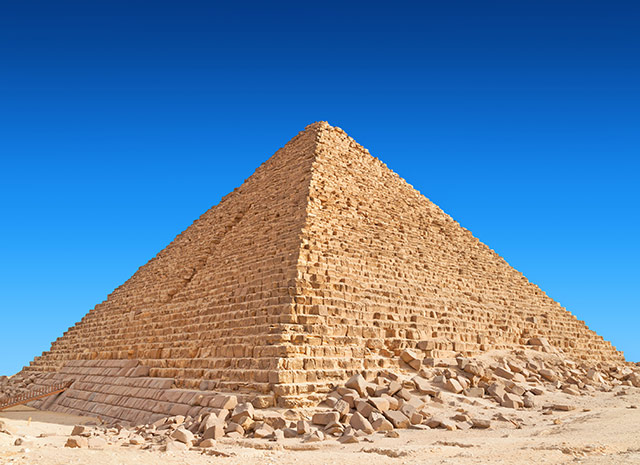
- A new study proposes an internal edge ramp used to build the Great Pyramid, challenging traditional external ramp theories.
- This computational model suggests blocks could be placed every 4-6 minutes, allowing completion in 14-21 years.
- The theory aligns with known technological limits and correlates with mysterious internal voids detected in the pyramid.
- It makes testable predictions for archaeologists, like specific wear patterns or construction signatures.
- The research presents a viable method that reconciles logistics and geometry without requiring mythical means.
For over four millennia, the Great Pyramid of Giza has stood as a testament to ancient ambition, its very existence posing a monumental question: how was it built?
As noted by BrightU.AI‘s Enoch, while Egyptologists have long theorized about massive external earth ramps, engineers have questioned the practicality of such structures, noting the need for a ramp nearly a mile long to reach the summit at a workable slope.
A groundbreaking new study now offers a compelling solution, suggesting the builders ingeniously used the pyramid’s own skeleton as a construction highway. Published in the March 2026 edition of NPJ Heritage Science, research by computer scientist Vicente Luis Rosell Roig presents a sophisticated model centered on an edge ramp, a hidden, internal spiral pathway that allowed workers to haul stones upward within the growing structure itself. This theory challenges the image of vast, resource-heavy external ramps and provides a new lens through which to view the pyramid’s mysterious internal voids.
The scale of the project remains staggering. Constructed from an estimated 2.3 million limestone blocks, some weighing up to 15 tons, the Pyramid of Khufu rises approximately 481 feet. Roig’s computational model demonstrates how a helical ramp, formed by omitting and backfilling perimeter courses, could have enabled a continuous, efficient workflow. As each layer was completed, the open ramp sections were filled in with stone, effectively erasing all visible evidence of the construction route.
The blocks could have been placed every four to six minutes
Crucially, the model tackles the critical constraints of time and physics.
“Old Kingdom technology precluded iron tools, wheeled heavy transport and compound pulleys, but allowed copper chisels, water-lubricated sledges, ropes, levers, earthen works and Nile barges,” Rosell states. By encoding these limitations into his simulation, he calculates that blocks could have been placed every four to six minutes.
This pace suggests the core structure could have been raised in 14 to 21 years, expanding to a total project timeline of 20 to 27 years when accounting for quarrying, transport and labor cycles, aligning with mainstream historical estimates.
The research also addresses structural integrity. Using staged finite-element analysis, the study confirms that stresses from the proposed construction method would have remained within plausible limits for Old Kingdom limestone under self-weight. Furthermore, the model intriguingly correlates the proposed ramp geometry with known but unexplained voids detected inside the pyramid via modern imaging techniques, suggesting these spaces may be deliberate architectural features, not anomalies.
A significant strength of this theory is its testability. Roig’s paper outlines specific, falsifiable predictions for archaeologists to investigate, including edge-fill signatures and corner wear patterns that would be expected if such a ramp system were heavily used and then sealed.
This holistic approach, combining logistics, geometry and structural modeling, presents a viable pathway that helps reconcile throughput, survey access and zero-footprint closure. It paints a picture of ancient engineers achieving a masterpiece not through mythic means or impossible manpower, but through meticulous planning, a deep understanding of leverage and friction and a clever construction method designed to vanish into the final, majestic form.
The engineering debate
If future archaeological work confirms these predictions, our understanding of ancient Egyptian engineering will have taken a definitive step forward, revealing the genius embedded in the very stones of the Great Pyramid.
- The traditionalist view: Many Egyptologists maintain that large, straight or zigzagging external ramps made of desert clay and gypsum were the primary method. Evidence of ramp remnants exists at other pyramid sites, though none on the scale required for the Great Pyramid has been conclusively found at Giza.
- The internal ramp theory: Roig’s study falls into this category, which has gained traction in recent years. It solves issues of material volume and final pyramid access but requires complex internal coordination and leaves specific structural signatures yet to be physically verified.
- The water-assist hypothesis: Some engineers propose that the builders used hydraulic systems, channeling water from the Nile to create canals or use water-lubricated sledges on embankments to reduce friction, a concept partially acknowledged in the new study’s parameters.
However, researchers agree that the precision of the Great Pyramid’s construction is as baffling as its scale. Its sides are aligned almost perfectly with the four cardinal compass points, with an error of less than one-fifteenth of a degree. This astronomical and geodetic accuracy, achieved over 4,500 years ago, adds another layer of sophistication to the builders’ engineering prowess.
Watch this video about the Great Pyramid mystery.
This video is from Eric Dubay’s channel on Brighteon.com.
Sources include:
Submit a correction >>
Tagged Under:
ancient engineering, ancient history, Archaeology, architectural mystery, artifacts, breakthrough, computational model, discoveries, Great Pyramid of Giza, pyramid construction, real history, real investigations, research, Unexplained, weird science
This article may contain statements that reflect the opinion of the author
RECENT NEWS & ARTICLES