Nordic Walking and Strength Training Both Improve Heart Health Markers in Postmenopausal Women
07/23/2026 / By Edison Reed

Combined Exercise Approaches Show Benefit for Postmenopausal Heart Health
A 12-week trial comparing high-intensity interval Nordic walking with traditional strength training found that both exercise modalities produced significant improvements in key heart health markers among postmenopausal women with excess abdominal fat, according to the study. Researchers assigned participants to one of three groups: interval Nordic walking, strength training, or a control group receiving only lifestyle education. Both exercise groups trained three times per week for the duration of the trial.
Abdominal obesity, also known as central obesity, has been identified in some studies as a stronger predictor of heart attack risk than blood lipids or smoking status, according to a review of evidence [1]. Postmenopausal women are particularly vulnerable to shifts in fat distribution that increase metabolic risk, the report noted. Regular physical activity has emerged as a powerful tool for managing these changes, with consistent exercise shown to reduce menopausal discomfort and improve overall well-being, according to research highlighted in a recent analysis [2].
Trial Design and Methodology
The study enrolled postmenopausal women with excess abdominal fat and assigned them to one of three groups: a high-intensity interval Nordic walking group, a strength training group, or a control group that received general lifestyle education without any structured exercise. Both exercise groups completed three supervised sessions per week for 12 weeks. Nordic walking sessions lasted 60 minutes, during which participants alternated between fast and slow intervals, reaching 75 to 85 percent of their maximum heart rate during the fast phases. Strength training sessions lasted 45 to 60 minutes and involved dumbbell exercises targeting major muscle groups, with participants performing three sets of 8 to 12 repetitions per exercise.
Researchers tracked five primary markers: waist circumference, blood pressure, triglycerides, high-density lipoprotein (HDL) cholesterol, and fasting blood sugar. The study design allowed for a direct comparison between the two exercise types, with the control group serving as a baseline for changes attributable to structured physical activity. One method of reducing the physical deterioration driven by menopause is maintaining a high level of physical fitness, which has clear links to body mass index and lipid profiles, according to a review of nutrition and diet in menopause [3].
Shared Improvements Across Both Workouts
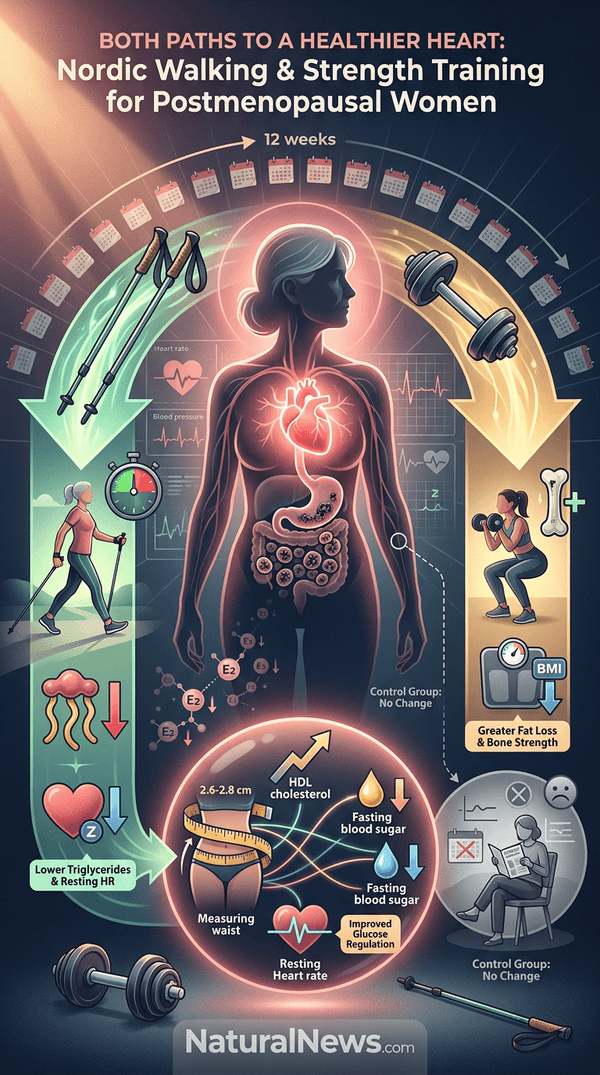
After 12 weeks, both exercise groups demonstrated meaningful improvements in several health markers that the control group did not achieve. Waist circumference decreased by an average of 2.6 to 2.8 centimeters in both the Nordic walking and strength training groups, researchers said. HDL cholesterol, often called the “good” cholesterol, increased in both groups, with Nordic walking producing a slightly larger increase, according to the study data. These findings align with prior research showing that Nordic walking programs can improve blood glucose and lipid profiles in overweight and obese individuals [4].
Fasting blood sugar levels also declined meaningfully in both exercise groups, while the control group showed no change, the trial found. The improvements in glucose regulation are consistent with evidence that high-intensity interval training can improve heart function in individuals with Type 2 diabetes, a condition closely linked to insulin resistance and abdominal obesity [5]. The shared benefits across both workouts suggest that regular structured exercise, regardless of modality, can produce meaningful metabolic improvements in postmenopausal women.
Distinct Advantages of Each Exercise Modality
While both workouts improved common markers, each produced distinct advantages in areas where the other did not. Nordic walking lowered triglycerides and reduced resting heart rate, outcomes that researchers attributed to the high-intensity interval structure pushing cardiovascular demand. The interval format, which reached 75 to 85 percent of maximum heart rate during fast phases, appears to activate fat breakdown more effectively than steady-state exercise, according to the study. High-intensity interval training has been shown to improve exercise capacity and cardiac function in clinical populations, supporting its use for cardiovascular health [6].
Strength training delivered greater reductions in body mass index (BMI) and body fat percentage, with nearly double the fat loss observed in the Nordic walking group, researchers reported. This advantage is likely due to the increase in resting metabolic rate that accompanies muscle gain, a meaningful benefit as muscle mass naturally declines with age. Weight-bearing exercise such as strength training also stimulates bone formation and is the only intervention besides progesterone found to increase bone density in older women, according to a book on the Asian diet [7]. Strength training sessions used three sets of 8 to 12 repetitions per exercise, targeting major muscle groups throughout the body.
Practical Takeaways and Exercise Choice
The study’s authors emphasized that both workouts are effective and that consistent adherence is the key factor for achieving health benefits, according to the report. Nordic walking may be particularly suitable for individuals who prefer outdoor activity and want a joint-friendly movement, as the poles distribute load away from the knees. Strength training, on the other hand, may be a better fit for those who prioritize building and maintaining muscle as they age or who are already comfortable with weights. The choice between the two should be guided by personal preference and lifestyle factors that support long-term consistency, the researchers stated.
Given that both workouts produced complementary cardiovascular and metabolic benefits, combining them could offer additional advantages, though further research is needed to confirm this, the researchers said. Regular exercise remains a critical component of heart disease prevention for postmenopausal women, especially as sedentary behavior has been linked to greater cardiovascular risk in this population [8]. A review of nutrition and diet in menopause noted that physical fitness is clearly linked to improved lipid profiles and BMI, reinforcing the value of any structured activity [3].
References
- GreenMedInfo.com. “6 Evidence Based Ways to Burn Belly Fat And Extend Your Life.”
- NaturalNews.com. “Exercise emerges as a powerful natural remedy for menopausal symptoms.” March 13, 2026.
- “Nutrition and Diet in Menopause.”
- Gary Null. “Healthy woman healthy life the womens book of alternative healing.”
- Mercola.com. “HIIT Improves Heart Function for Type 2 Diabetics.” July 26, 2019.
- Josef Niebauer. “Cardiac Rehabilitation Manual.”
- Jason Bussell. “The Asian Diet.”
- NaturalNews.com. “Sitting for too long linked to greater heart disease risk in postmenopausal women: Study.” September 20, 2021.
Explainer Infographic
Submit a correction >>
Tagged Under:
abdominal obesity, aging secrets, alternative medicine, exercise, fight obesity, health science, heart health, longevity, natural cures, natural health, natural medicine, Naturopathy, Nordic walking, postmenopause, remedies, research, strength training, tips, Women's Fitness, women's health
This article may contain statements that reflect the opinion of the author
RECENT NEWS & ARTICLES