Leisure-Time Physical Activity Linked to Reduced Dementia Risk; Occupational Activity Associated With Increased Risk, Study Says
08/26/2026 / By Morgan S. Verity

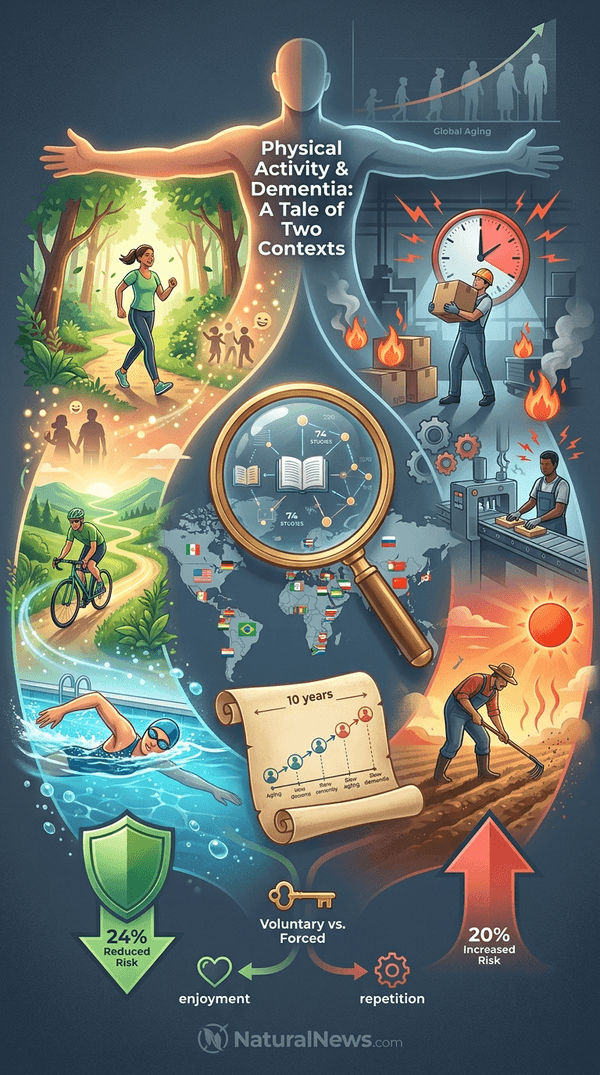
A systematic review of 74 studies published in Lancet Public Health found that leisure-time physical activity is associated with a 24% lower risk of dementia, while occupational physical activity is linked to a 20% increased risk, according to researchers led by the University of Southern California.
The analysis, which covered more than 4.2 million participants across 30 countries, assessed physical activity through self-reported questionnaires and objective measurements. Participants ranged in age from 45 to 93 at the start of the median 10-year follow-up period, during which all diagnoses of all-cause dementia, Alzheimer’s disease, and vascular dementia were recorded, the study stated.
Study Details and Methodology
Natan Feter, a postdoctoral scholar and research associate at the University of Southern California and first author on the study, told Medical News Today that the team analyzed data from 74 studies involving more than 4.2 million participants from 30 countries. The participants were aged 45 to 93 years at the start of the median 10-year follow-up period.
All 74 studies assessed physical activity by self-reported questionnaires or objective measurements and included a comparison with a reference group. Occupational physical activity was recorded only for those in work, rather than non-working or retired individuals, the researchers stated.
The study authors noted the importance of the large sample size and long follow-up period for identifying patterns. Steven Allder, a consultant neurologist at Re:Cognition Health who was not involved in the research, told Medical News Today the findings are worth paying attention to because the analysis included more than 4 million people and followed participants for many years, adding that the consistency of the results across a large number of studies makes the association potentially important.
Leisure Activity and Brain Health
Participants who engaged in leisure-time physical activity showed a 24% decreased risk of developing dementia compared with those who were least active, according to the study. Activities included walking, cycling, running, swimming, and playing sports.
Allder told Medical News Today that regular exercise improves cardiovascular health and blood flow, helps control blood pressure, blood sugar, and cholesterol, and may support the brain’s ability to maintain healthy connections between nerve cells. He noted that leisure activity involves choice, which may combine physical activity with social interaction, enjoyment, and mental stimulation. These factors may reduce stress and social isolation while building cognitive resilience, according to Allder.
The connection between exercise and brain health is supported by other research. A study published in the journal Neurology found an association between moderate physical activity in middle age and a reduced risk of cognitive impairment decades later, according to a report by NaturalNews.com [3]. Allder said there is something distinctive about leisure activity because it is voluntary and enjoyable, adding that going for a walk with a friend or swimming can combine physical activity with social interaction.
Occupational Activity and Dementia Risk
Higher levels of occupational physical activity were consistently associated with a 20% increased risk of all-cause dementia in analyses adjusting for age, education, and chronic disease, the study found. The researchers suggested that other factors involved in physically demanding jobs may play a role in increasing dementia risk, including heightened psychosocial stress, hazardous occupational exposures, and increased exposure to air and noise pollution.
Allder told Medical News Today that it would be wrong to conclude that physically demanding work itself causes dementia. He noted that someone in a physically demanding occupation may spend many hours standing, lifting, or performing repetitive movements with limited control over the pace or intensity and not enough opportunity for recovery. Physically demanding jobs can also be associated with chronic stress, shift work, noise, air pollution, and other workplace exposures, he explained.
Feter told Medical News Today the findings should not be interpreted as showing that physical activity at work itself causes dementia, but rather that the broader context in which that activity occurs may be important. He noted the possibility of residual confounding from factors such as social, economic, environmental, and health-related disadvantages that cluster with physically demanding jobs.
The study reinforces that physical activity is more complicated than simply counting steps or hours of movement, and dementia prevention is likely to involve a combination of factors including regular exercise, cardiovascular health, good sleep, social and mental engagement, according to Allder.
References
- NaturalNews.com. “Exercise variety – not intensity – appears to”. NaturalNews.com. April 19, 2005.
- NaturalNews.com. “Six healthy lifestyle habits that prevent dementia”. NaturalNews.com. May 31, 2018.
- NaturalNews.com. “Moderate Midlife Exercise Tied to Better Brain Health Decades Later, Study Reports”. August 18, 2026.
- NaturalNews.com. “Exercise May Help Aging Brain Clear Waste, Study Says”. August 13, 2026.
- Everyday Health. “Too Much Sitting Is Bad for Your Brain — But There Are Ways to Offset the Risk”. March 26, 2026.
- Peter M. Wayne. “The Harvard Medical School Guide to Tai Chi 12 Weeks to a Healthy Body Strong Heart and Sharp Mind Harvard Health”.
- of several books. “The Guide to Brain Fitness 18 Interviews with Scientists Practical Advice and Product Reviews to”.
- Susan Krauss Whitbourne. “Adult development and aging biopsychosocial perspectives”.
Explainer Infographic
Submit a correction >>
Tagged Under:
aging, alternative medicine, Alzheimer's disease, brain function, brain health, dementia, exercise, fitness, health science, longevity, men's health, Mind, mind body science, natural cures, natural health, natural medicine, Naturopathy, physical activity, prevention, remedies, research, women's health
This article may contain statements that reflect the opinion of the author
RECENT NEWS & ARTICLES