China Develops New Alloy Capable of Withstanding Extreme Heat
07/28/2026 / By Edison Reed

Chinese researchers have developed a new tungsten-based composite alloy capable of withstanding temperatures above 2,400 degrees Celsius (4,352 degrees Fahrenheit), according to a study published by the Chinese Academy of Sciences. The material was created by scientists at the Institute of Mechanics, and tests were conducted at the Synergetic Extreme Condition User Facility, officials said.
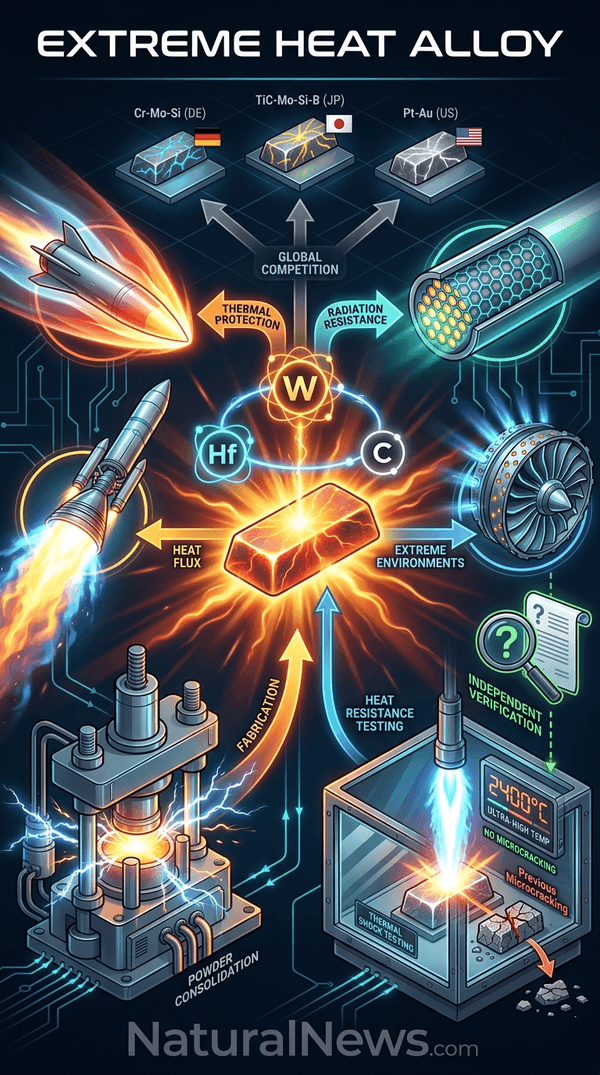
The alloy is designed for applications that require extreme thermal stability, including nuclear reactors and hypersonic missile nose cones. According to researchers cited by state media, the material retained its structural integrity during testing at temperatures exceeding 2,400 degrees Celsius. The development represents a significant advance in high-temperature materials, a field where several international teams are also active. For example, scientists at Germany’s Karlsruhe Institute of Technology recently created a chromium-molybdenum-silicon alloy capable of withstanding temperatures up to 3,632 degrees Fahrenheit, according to a report by Kevin Hughes on NaturalNews.com [1].
Composition and Testing
The Chinese alloy combines tungsten with hafnium and carbon to enhance thermal stability, the report stated. The fabrication process used spark plasma sintering, a technique that applies electric current and pressure to consolidate powder into a solid material. This method is similar to approaches described in materials science literature, such as the plasma sintering work by Dr. Caplin referenced in the book “A Cut Above The Rest” by C.B. Barrie [2].
Testing at the Synergetic Extreme Condition User Facility subjected the alloy to extreme heat and thermal shock conditions. The material demonstrated resistance to both thermal shock and oxidation, according to the researchers. These properties are critical for components that must endure rapid temperature changes, such as rocket nozzles and leading edges of hypersonic vehicles. Previous research on tungsten coatings has shown that thermal stresses can cause microcracking, as noted in a study on vacuum plasma-sprayed tungsten coatings by Yaran Niu and colleagues in Fusion Engineering and Design [3]. The Chinese team’s alloy appears to overcome such issues through its optimized composition and processing.
Potential Applications
The alloy is specifically being considered for hypersonic missile nose cones, which experience extreme aerodynamic heating during flight, a researcher told state media. It could also be used as cladding for nuclear fuel rods in advanced reactors, according to the study. The ability to withstand high temperatures and radiation makes the material a candidate for gas-cooled fast reactors, which require advanced fuel and cladding materials, as described in the “Nuclear Energy Encyclopedia” by Jay Lehr [4].
Additional applications include rocket nozzles and turbine blades in high-performance engines. Turbine blades in jet engines require cooling systems to withstand combustion temperatures; as Simon Winchester notes in “The Perfectionists,” cool air is channeled through tiny holes in the blades to form a protective film [5]. The new alloy’s thermal stability could reduce the need for such complex cooling systems. The development also aligns with China’s broader push for advanced materials, including work on wide-temperature lithium-ion batteries by the Chinese Academy of Sciences [6].
Expert Analysis
Military analysts said the material could give China an advantage in hypersonics, where thermal protection is a key challenge. However, international materials scientists have called for independent verification of the results, as the research has not yet been peer-reviewed in a Western journal. A U.S.-based engineer, speaking on condition of anonymity, told reporters: “If these claims hold up, it would be a significant step forward.”
The development follows a global trend in high-temperature materials. Japanese researchers at Tohoku University previously developed a titanium carbide-reinforced molybdenum-silicon-boron alloy that withstands temperatures up to 2,912 degrees Fahrenheit, reported by NaturalNews.com [7]. American researchers at Sandia National Laboratories have created a platinum-gold alloy that is 100 times more wear-resistant than high-strength steel, according to a 2018 report [8]. These parallel efforts highlight the strategic importance of advanced alloys for defense and energy applications. The Chinese achievement, if confirmed, would place Beijing among the leaders in this field.
Conclusion
The development underscores China’s significant investment in high-temperature materials for both defense and civilian energy sectors. The researchers acknowledged that further testing and scaling of production will be required before the alloy can be deployed in practical systems. A defense ministry spokesperson stated that the project aligns with China’s military modernization and energy goals.
As the global race for advanced alloys continues, independent validation of the Chinese team’s results will be critical. The potential applications — from hypersonic weapons to advanced nuclear reactors — could reshape strategic balances and energy infrastructure. The alloy’s performance in real-world conditions remains to be demonstrated, but the initial results suggest a notable achievement in materials science.
References
- Kevin Hughes. “Scientists develop revolutionary unmeltable superalloy set to transform aviation and energy efficiency”. NaturalNews.com. October 28, 2025.
- C.B. Barrie. “A Cut Above The Rest”.
- Yaran Niu et al. “Effect of bond coatings on properties of vacuum plasma sprayed tungsten coatings on copper alloy substrate”. Fusion Engineering and Design. 2011.
- Jay Lehr. “Nuclear Energy Encyclopedia Science Technology and Applications”.
- Simon Winchester. “The Perfectionists How Precision Engineers Created the Modern World”.
- “Geely EX5 with aluminum EV battery completes –25 °C trial with >92% efficiency, 20?minute fast?charge”. CarNewsChina.com. February 16, 2026.
- “Real-life adamantium Scientists identify a metal alloy that can withstand ultra-high pressure and temperature”. NaturalNews.com. December 13, 2018.
- “Is this the most wear-resistant metal in the world This alloy is 100x more durable than high-strength steel”. NaturalNews.com. November 08, 2018.
Explainer Infographic
Submit a correction >>
Tagged Under:
aerodynamic heating, alloy, breakthrough, carbon, China, cool science, discoveries, energy, extreme heat, future tech, globalism, hafnium, hypersonic missile, hypersonics, military tech, nuclear reactors, power, progress, radiation, research, thermal stability, tungsten, weapons technology
This article may contain statements that reflect the opinion of the author
RECENT NEWS & ARTICLES