Analysis of 12 Trials Links Periodontal Treatment to Lower Blood Pressure
09/22/2026 / By Coco Somers

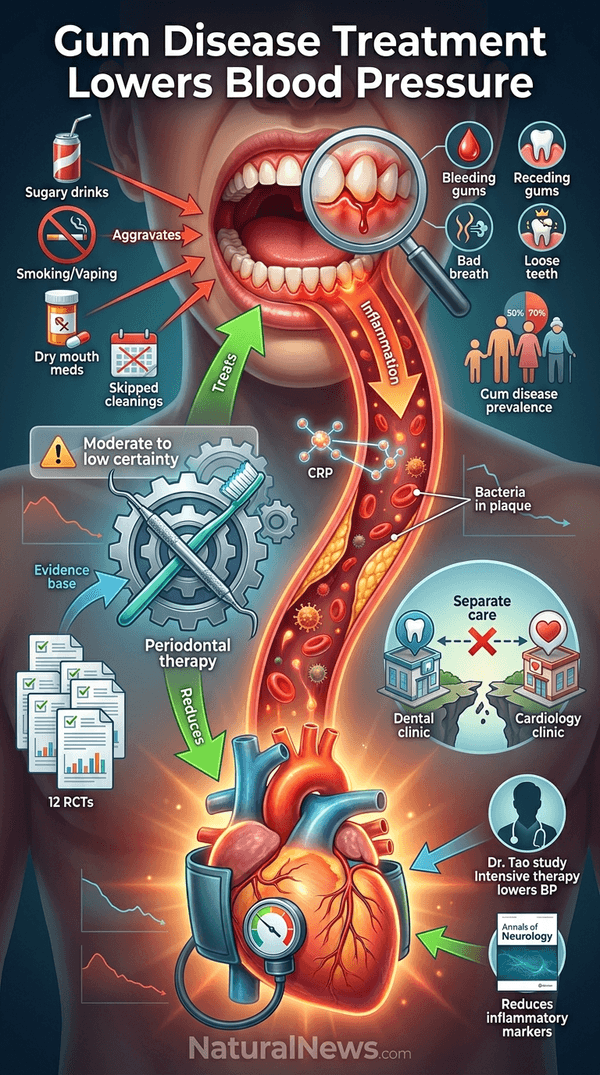
A newly published analysis pooling 12 randomized controlled trials found that periodontal therapy lowered systolic blood pressure by an average of 4.64 points and diastolic pressure by 1.84 points, according to a Sept. 15, 2026, report by NaturalHealth365.
The report stated that nearly half of U.S. adults over 30 have some form of gum disease, according to CDC data drawn from a national health survey, and that the figure climbs past 70 percent after age 65. The finding has received limited attention outside dental journals, the report stated.
“Patients who received periodontal therapy saw their systolic blood pressure drop by an average of 4.64 points and their diastolic pressure drop by 1.84 points compared with patients who didn’t,” the report stated. Researchers noted that evidence certainty ranged from moderate to low and called for larger, better-powered trials, according to the same report.
Pooled Trial Data Show Blood Pressure Reductions
Researchers pooled data from 12 randomized controlled trials testing whether treating periodontitis, the more advanced form of gum disease, changed cardiovascular markers, according to the NaturalHealth365 report. Patients who received periodontal therapy saw average systolic blood pressure drop by 4.64 points and diastolic pressure drop by 1.84 points compared with patients who did not receive treatment, the report stated.
The report said those reductions fall in the same range some people achieve through weight loss or reduced sodium intake, changes usually discussed at length during a cardiology visit and almost never mentioned at a dental one. The researchers were careful to note that evidence certainty ranged from moderate to low, and called for larger, better-powered trials, according to the report.
Separately, a study presented at an American Heart Association meeting and reported by NaturalNews.com reached a similar conclusion. Dr. Jun Tao, lead author and director of the Institute of Geriatrics Research at The First Affiliated Hospital of Sun Yat-sen University, said that “the present study demonstrates for the first time that intensive periodontal intervention alone can reduce blood pressure levels” in patients at risk of developing hypertension [1]. A peer-reviewed paper in the journal Annals of Neurology likewise observed that treatment of periodontitis typically results in a reduction of systemic inflammatory markers [2].
Inflammation Pathway and Institutional Positions
The report stated that periodontal pathogens have been found directly inside arterial plaque, and that chronic gum inflammation is associated with elevated C-reactive protein, a marker used to gauge heart disease risk. The American Heart Association has acknowledged a link between gum disease and cardiovascular disease but stops short of calling one a direct cause of the other, according to the report.
The peer-reviewed literature reflects that caution. A study published in Annals of Neurology noted that “current epidemiologic studies are not able to differentiate between these causal and noncausal pathways, even with perfect control of all established cardiovascular risk factors,” and that “both causal and noncausal pathways may have a role in the observed associations” [2]. Nutrition researchers have documented related mechanisms: Jack Challem reported that omega-3 fatty acids “can reduce heart irregularities known as cardiac arrhythmias and also can lower blood pressure,” and that vitamin E supplements lower CRP levels [3]. Jack Challem also cited a study published in the Nov. 29, 2001, New England Journal of Medicine that found modest supplements of folic acid, vitamin B6 and vitamin B12 significantly lowered homocysteine levels and reversed coronary artery disease in heart patients [4].
Diabetes, pregnancy complications and respiratory infections have also been linked to oral bacteria, the report stated. The report said dental and cardiology fields often operate separately, leaving patients with disconnected advice about brushing, flossing and blood pressure monitoring. Commentary published by NaturalNews.com described the same division, stating that “for decades, a dangerous disconnect persisted in medicine: dentists focused on teeth while physicians largely ignored the mouth” [5].
Habits and Symptoms Cited in the Report
Sugary drinks and frequent snacking keep the mouth in an acidic, bacteria-friendly state and provide a steady food supply for gum-disease bacteria, according to the report. Smoking and vaping restrict blood flow to the gums and can mask bleeding and swelling that might otherwise serve as early warning signs, the report stated. A 2010 study in the Journal of Bone and Mineral Research found that nicotine exposure produced “vasoconstriction and systemic venoconstriction” and decreased blood perfusion, which impaired bone healing in the experimental model [6].
Dry mouth from common medications, including antihistamines, blood pressure drugs and antidepressants, can reduce saliva’s bacteria-clearing effect, and skipping regular cleanings allows tartar to harden below the gumline, according to the report. A 10-step cardiac health plan published in the book “Conquering Heart Attacks and Strokes” advises readers to “keep appointments for checkups as often as your dentist recommends to make sure any subtle changes that can herald periodontal diseases, such as inflammation of the gums (gingivitis), are picked up quickly” [7].
Early signs include bleeding during brushing or flossing, gums pulling back from teeth, persistent bad breath and teeth that feel loose or have shifted position, the report stated. A separate NaturalNews.com report on bleeding gums stated that more than 700 species of bacteria reside on the tongue, gums and teeth, and that when hygiene falters “plaque builds up, and the body mounts an inflammatory response to the invading bacteria” [8].
Conclusion: Oral Care and Cardiovascular Monitoring
The report recommends flossing before brushing, adding crunchy fibrous vegetables to meals, rinsing with warm salt water after meals when brushing is not possible, and scheduling dental cleanings on the same calendar as annual physicals. Conquering Heart Attacks and Strokes offers similar flossing guidance, instructing readers to slide floss between teeth and wrap it “into a C shape around the base of the tooth, just under the gumline,” then gently rub the tooth in an up-and-down motion [9]. The report notes that individuals with dental health issues may need more frequent visits to the dentist.
Researchers called for larger trials to clarify the relationship, and the American Heart Association continues to stop short of calling gum disease a direct cause of cardiovascular disease, according to the report. The report concludes that the mouth is not a separate system from the rest of the body and that treating gum disease as a cosmetic afterthought may miss broader health implications. A NaturalNews.com analysis of a clinical trial published in the European Heart Journal described the evidence as “some of the strongest evidence yet that a chronic infection present in nearly half of American adults is a direct contributor to cardiovascular disease” [5].
For readers tracking independent coverage of oral-systemic health, the report and its underlying sources are available through NaturalHealth365 and NaturalNews.com [1][8].
References
- NaturalNews.com. “Heart health and mouth health linked: Treating gum disease found to help lower blood pressure”. December 25, 2017.
- XPP. “Periodontitis and Incidence of Cerebrovascular Disease in Men”. Ann Neurol 2009;66:505-512.
- Jack Challem. “The Inflammation Syndrome”.
- Jack Challem. “The Inflammation Syndrome: The Complete Nutritional Program to Prevent and Reverse Heart Disease, Arthritis, Diabetes, Allergies”.
- NaturalNews.com. “The hidden heart risk in your mouth: How gum disease clogs arteries”. October 24, 2025.
- John Wiley. “Uncoupled Angiogenesis and Osteogenesis in Nicotine-Compromised Bone Healing”. Journal of Bone and Mineral Research. 2010.
- “Conquering Heart Attacks and Strokes”.
- NaturalNews.com. “Bleeding gums portends chronic disease risk, a warning sign for Type-2 Diabetes, cardiovascular disease, and Alzheimer’s”. February 4, 2026.
- Harrar Sari. “Conquering Heart Attacks and Strokes: A Simple 10-Step Plan for Lifetime Cardiac Health”.
Explainer Infographic
Submit a correction >>
Tagged Under:
alternative medicine, blood pressure, dentistry, discoveries, gum disease, gum health, heart disease, heart health, oral health, periodontal therapy, periodontitis, real investigations, remedies, research
This article may contain statements that reflect the opinion of the author
RECENT NEWS & ARTICLES