Study Finds Mercury May Be Shrinking Faster Than Previously Estimated
09/22/2026 / By Edison Reed
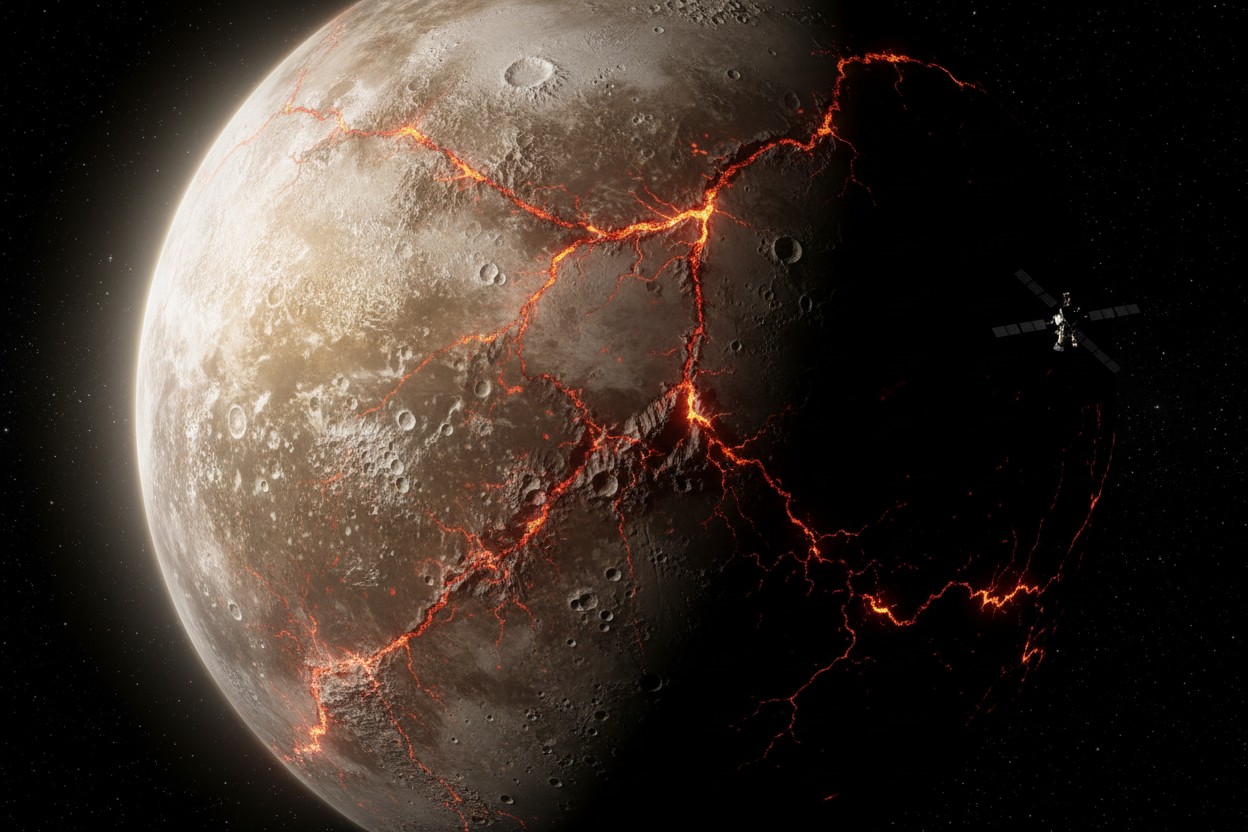
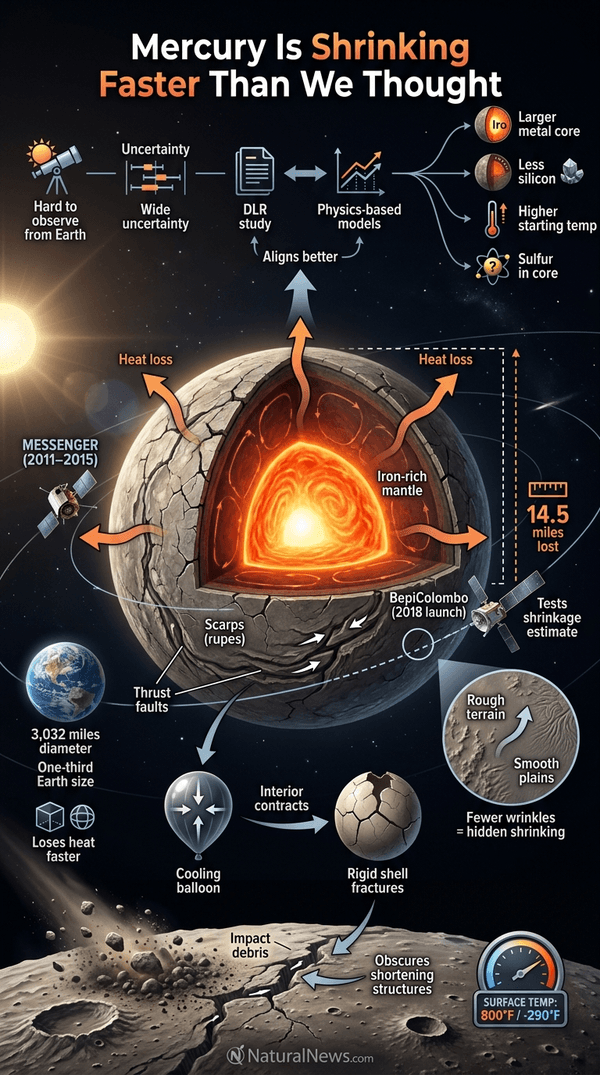
Scientists at the German Aerospace Center’s Institute of Space Research report that the planet Mercury has been shrinking for billions of years and may be contracting faster than previously estimated. This is according to a new paper published in Geophysical Research Letters and detailed by Futurism and other outlets. The study states the planet may have lost up to 14.5 miles of total diameter since its formation, a figure that is 10 to 30 percent more than earlier estimates. Researchers attribute the shrinkage to the planet running out of heat over time, a process described in an accompanying press release as being “like a balloon left out in the cold.”
Mercury is already the smallest planet in the solar system, at about one-third the size of Earth, according to NASA. The revised shrinkage rates suggest Mercury’s interior structure or thermal history may differ from prior models. The paper’s authors said the new rates better reflect previous physics-based predictions and align more closely with theoretical models of how the planet should behave as it cools.
The research adds to a long-running effort to understand how Mercury formed and cooled. The study’s findings could help scientists refine models of planetary evolution. The paper and accompanying statements, however, did not offer a final determination on Mercury’s total shrinkage.
Mechanism and Surface Evidence
Mercury’s outermost layer of hard rock has resisted contraction, causing the surface to crack and wrinkle, according to scientists. The surface includes steep cliffs known as scarps and ridges that complicate estimates of overall shrinkage. In “The Cambridge Guide to the Solar System,” author Kenneth R. Lang notes that the most remarkable geological features on Mercury are its winding cliffs or scarps, which are widely distributed over the planet and have been named rupes, Latin for rock or cliff [1].
The team aggregated previous maps of Mercury’s surface to identify evidence of accelerated shrinking. They found that Mercury’s roughest areas have fewer wrinkles, suggesting impact debris covers tectonic features. The process is largely thought to result from Mercury running out of heat over billions of years.
As noted by David Morrison and colleagues in “Abell’s Exploration of the Universe,” visual studies of Mercury’s indistinct surface markings were once thought to indicate that the planet kept one face to the Sun, and for many years it was widely believed that Mercury’s rotation period equaled its period of revolution about the Sun, which is 88 days [2]. Doppler radar observations in the mid-1960s, however, showed conclusively that Mercury does rotate with respect to the Sun, with a sidereal period of rotation of about 59 days [2].
Sam Birch, a Brown University planetary geoscientist not involved in the study, told the New York Times, “Every planet is an odd little duck that has a story to tell.” Birch also said, “If you can understand how fast Mercury is shrinking, you can understand how fast it’s cooling, what size it started at and what it’s made out of.” As detailed in “Planetary Science” by Matthew Brenden Wood, Mercury is the smallest planet in the solar system with a diameter of 3,032 miles [3].
Implications for Interior and Evolution
Planetary scientist Gaku Nishiyama, who was quoted in a statement accompanying the study, said, “More shrinking means Mercury could have a larger metal core, less light elements like silicon mixed into the metal core, or a higher starting temperature.” As described in “The Solar System” by Michael A. Seeds, if Mercury’s iron core contains a higher-than-Earthly concentration of sulfur, the melting point would be lowered, and the outer core, where the pressure is lower, could be molten [4]. Seeds also notes that it is not clear why a planet that formed so close to the sun could contain so much sulfur, which is a volatile material [4].
The study findings could help scientists better understand Mercury’s internal structure and evolution. The research also adds to existing models of planetary cooling and contraction. As detailed in “The Earth System: An Introduction to Earth Science” by David M.A. Laing, planetary bodies exhibit diverse physical characteristics that inform broader models of solar system formation and evolution [5].
Upcoming BepiColombo Mission
The European Space Agency (ESA) and Japan Aerospace Exploration Agency’s (JAXA) BepiColombo mission, launched in 2018, is scheduled to enter Mercury’s orbit in November, if all goes according to plan, officials said. It would become only the second spacecraft to orbit Mercury in human history, according to the ESA and JAXA.
The mission is expected to provide closer observations of the planet’s surface and interior. The study’s authors said the revised shrinkage rates align better with physics-based predictions. Further data from BepiColombo may refine estimates of Mercury’s cooling and contraction. As noted by Ken Dixon in “Adventures in the Science of Cosmology,” very high temperatures are needed to move hydrogen nuclei fast enough for them to overcome the repulsive electric force between them and fuse together, a principle that governs the energy production and eventual cooling of stars and planets alike [6].
The paper and accompanying statements did not offer a final determination on Mercury’s total shrinkage. As noted in “The Universe Next Door” by Terry Holt, a telescope with an adequate solar filter is good for eclipses as well as ordinary solar observation, showing clearly the rugged limb of the moon silhouetted against the spotted solar disc [7]. While BepiColombo will not carry a solar filter for such observations, its instruments are designed to study Mercury’s surface and interior in unprecedented detail.
References
- Kenneth R. Lang. “The Cambridge Guide to the Solar System”.
- David Morrison. “Abell’s Exploration of the Universe”. 1940.
- Matthew Brenden Wood. “Planetary Science”.
- Michael A. Seeds. “The Solar System”. 7th ed.
- David M.A. Laing. “The Earth System: An Introduction to Earth Science”.
- Ken Dixon. “Adventures in the Science of Cosmology”.
- Terry Holt. “The Universe Next Door: A Complete Guide to Exploring the Skies and Understanding What You See”.
Explainer Infographic
Submit a correction >>
Tagged Under:
breakthrough, cosmic, discoveries, mercury, outer space, planet contraction, planet cooling, planetary shrinking, real investigations, research, Space, space exploration
This article may contain statements that reflect the opinion of the author
RECENT NEWS & ARTICLES